Steel Pressed Pier Installation in New Braunfels, TX
We lift heavy settling slabs by driving galvanised steel piers to load-bearing strata, using the weight of the home itself to prove every pier before it carries the house.
Schedule a Free Estimate
Tell us about your project and we will get right back to you.
Need foundation repair work done right around New Braunfels?
New Braunfels Foundation Repair HQ has been pressing steel piers under settling slabs in New Braunfels, Texas for more than 18 years. A steel pressed pier is a column of galvanised steel sections driven into the ground one section at a time by a hydraulic ram, using the weight of the house itself as the force that pushes each section down. The sections keep going until the pier meets load-bearing strata and refuses to move, and at that moment the pier has already been tested against more force than the home will ever rest on it. Because every pier is driven to refusal rather than to a preset depth, the system adapts to the soil under each individual footing. That makes it our first recommendation for heavy slab settlement, the most common foundation problem we see in this part of Texas.
Signs You Need Steel Pressed Pier Installation
How Steel Pressed Pier Installation Works on New Braunfels Clay
The ground under New Braunfels changes character block by block. The town straddles the Balcones Fault, with Hill Country limestone rising to the west and expansive blackland clay spreading under much of the city and everything east of it. That clay takes on water and swells in a wet spring, then dries and contracts through a Central Texas summer, and a slab poured on top of it rises and falls with every cycle. Repairing a foundation here means getting its weight off the clay that moves and onto the stratum below it that does not, and the depth of that stratum varies from one lot to the next.
A steel pressed pier handles that variation better than any fixed-depth system. Our crew opens a small access pit at the grade beam, seats a hydraulic ram between the beam and the first galvanised steel section, and presses the section straight down, with the mass of the house acting as the anchor the ram pushes against. A new section is stacked on and the drive continues, section after section, while the gauge on the ram tracks the resistance below. When the pressure reading spikes and holds, the pier has met load-bearing strata and will not advance, and the drive stops there. If firm bearing sits at 14 feet under one corner and 22 feet under the next, each pier simply stops where its own soil says to stop.
That drive-to-refusal design is also a built-in proof test. Each pier is installed under more force than the portion of the house it will carry, so its capacity is demonstrated before the first bracket goes on. The method does ask one thing in return: it needs the weight of a substantial structure above it to press against, which is why it is matched to full masonry homes and heavy slabs rather than porches and light additions. Where a footing is too light to supply that reaction force, a torque-driven helical pile does the equivalent job from the opposite direction, advancing under its own hydraulic rotation instead of under the structure's mass. And compared with concrete pressed cylinders, the slimmer steel sections penetrate deeper through stiff clay, which matters on the deep-soil lots around town. On a settling main slab, steel pressed piers are the backbone of most of the slab foundation repair work we do.
Our Steel Pressed Pier Installation Process
Steel Pressed Pier Installation Cost in New Braunfels
Recent Steel Pressed Pier Installation Projects
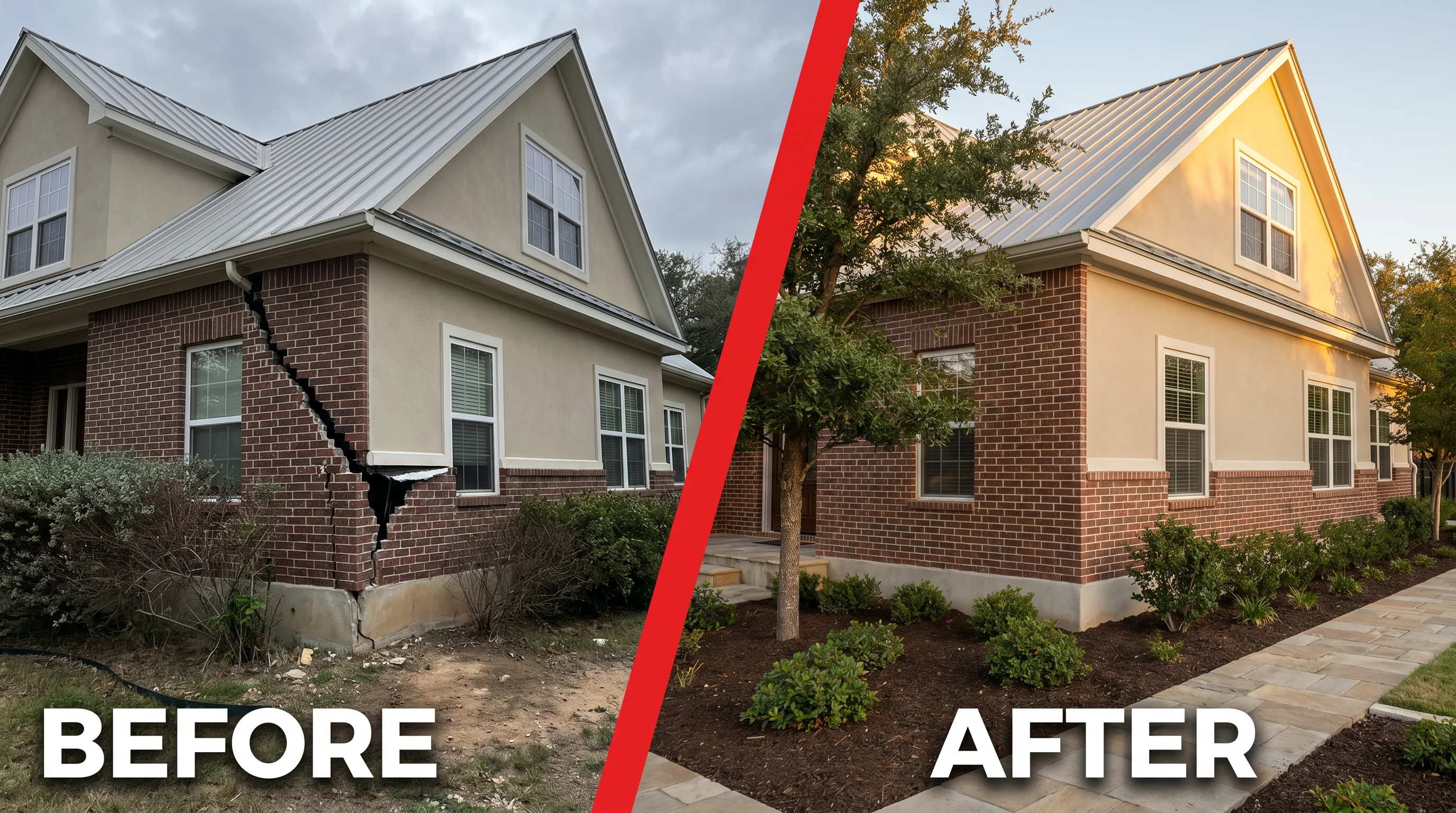
The pattern repeats across New Braunfels neighbourhoods: a garage-side corner that dropped through a drought summer, a back wall settling where the yard drains poorly, a den at the end of a slab that was extended decades ago. In each case the fix is the same sequence, piers pressed to refusal along the affected beam and the slab lifted back level. The image below is an illustration of what that repair looks like, before and after, rather than a photograph of a specific completed job.
Call (830) 302-3236Why Choose New Braunfels Foundation Repair HQ
We work on foundations only, across New Braunfels and the surrounding Comal and Guadalupe County communities. If you are weighing whether your slab needs pressed piers at all, start with a conversation with a local foundation specialist and we will measure the slab before recommending anything.