Retaining Wall Repair in New Braunfels, TX
We pull bowing, leaning retaining walls back to plumb with tieback anchors and real drainage, and rebuild the walls on New Braunfels' terraced Hill Country lots that are past saving.
Schedule a Free Estimate
Tell us about your project and we will get right back to you.
Need foundation repair work done right around New Braunfels?
New Braunfels Foundation Repair HQ repairs, reinforces, and rebuilds retaining walls across New Braunfels, Texas, and has for more than 18 years. Much of the housing here is cut into hillsides. Neighborhoods climb the slopes west of town toward the Hill Country, and builders terrace those lots with retaining walls so a flat pad can hold a house, a driveway, or a pool. Every one of those walls spends its life holding back a wedge of soil that gets heavier each time it rains. When the wall starts to bow, lean, or crack, the soil is winning, and the fix is a matter of engineering rather than patching. We straighten and anchor walls that can be saved, and we rebuild the ones that cannot.
Signs You Need Retaining Wall Repair
How Retaining Wall Repair Works on New Braunfels Clay
New Braunfels sits on the Balcones Fault, where Hill Country limestone drops off into expansive prairie clay. On the terraced lots around town, a retaining wall often holds back fill dirt with a high clay content, and that clay is the real opponent. It swells when it soaks up rain and shrinks in drought, so the pressure on the back of the wall is never constant. Add a Central Texas downpour and the soil behind an undrained wall becomes saturated. Water cannot pass through the wall, so it pushes on it. That hydrostatic pressure, stacked on top of clay swell, is what bows and topples walls on Comal County slopes.
Our repairs attack both halves of that problem, the pressure and the wall's ability to resist it.
On the pressure side, we open up the ground behind the wall and build the drainage the wall should have had from day one: free-draining gravel backfill, a perforated drain pipe at the heel that carries water out to daylight, and clear weep holes through the face. Once water has somewhere to go, the load on the wall drops sharply after every storm instead of building behind it. Where roof runoff or a sloping yard keeps feeding water to the wall, we correct the grading and downspouts uphill of it so the wall stops catching the whole lot's runoff.
On the strength side, we anchor the wall to soil that is not moving. A tieback anchor is a steel rod or helical anchor installed through the wall face and driven back into the stable ground well behind the failure zone. A plate on the wall face connects the two, and tensioning the anchor pulls a bowing wall back toward plumb and holds it there. Anchors let us save many walls that look far gone, because the wall itself is often sound; it simply lost the fight against the soil. When the structure is too broken to save, crushed block, a sheared footing, a timber wall rotted through, we excavate and rebuild it as an engineered wall with the reinforcement and drainage sized for the actual slope. The same clay movement that pushes on these walls is what cracks and settles slab foundations across town, so if the house above the wall shows symptoms too, we assess both in one visit.
Our Retaining Wall Repair Process
Retaining Wall Repair Cost in New Braunfels
Recent Retaining Wall Repair Projects
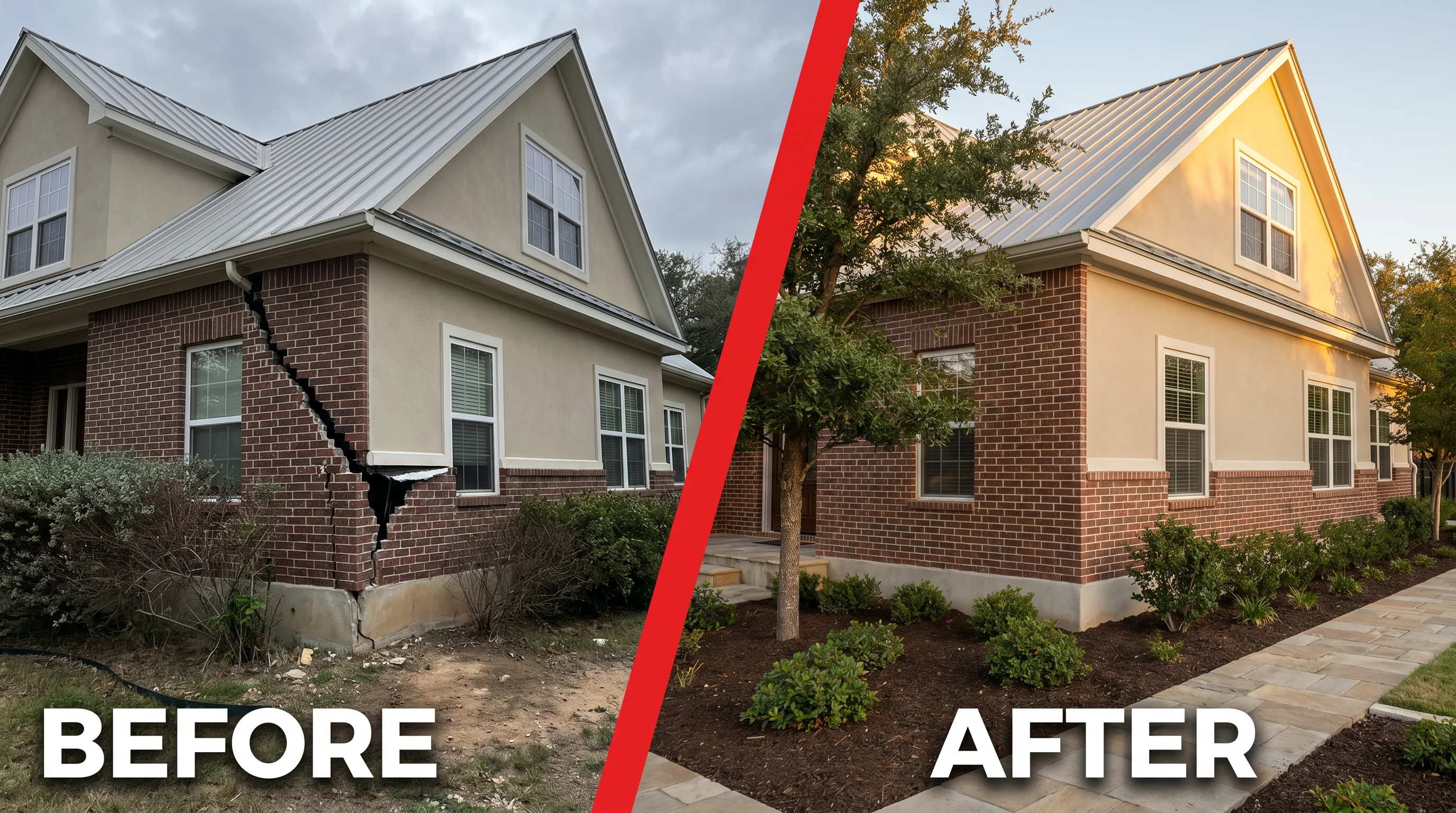
The walls we work on around New Braunfels follow the terrain. On the terraced streets climbing toward the Hill Country, that is usually a block or masonry wall bowing at mid-height with no drain behind it, brought back to plumb with helical tiebacks and rebuilt backfill. On older properties nearer the rivers, it is often a timber or stone wall past saving, replaced with an engineered segmental wall that finally drains. Driveway walls, pool terraces, and walkout basements each get the anchor layout their load calls for.
Call (830) 302-3236Why Choose New Braunfels Foundation Repair HQ
We repair retaining walls, foundations, and drainage for homes and small commercial properties across New Braunfels and the surrounding Comal and Guadalupe County towns. If you are watching a wall lean a little further every season, start with a conversation with a local specialist and we will measure it before recommending anything.