Helical Pier Installation in New Braunfels, TX
We stabilise porches, additions, columns and tight-access footings with torque-verified helical piles seated below New Braunfels' shifting Balcones Fault clay.
Schedule a Free Estimate
Tell us about your project and we will get right back to you.
Need foundation repair work done right around New Braunfels?
New Braunfels Foundation Repair HQ has installed helical piers across New Braunfels, Texas for over 18 years. A helical pier, also called a screw pile, is a galvanised steel shaft with one or more helix plates welded near the tip. Our crew turns it into the ground hydraulically, the way you would drive a large screw, until it reaches the torque that matches the load your structure needs. Because a helical pile carries its capacity on those helix plates rather than on the weight of the building above it, it is the pier we reach for on lighter structures, tight-access spots, and the deep-clay and high-water-table lots that give the New Braunfels area so much foundation trouble.
Signs You Need Helical Piers
How Helical Piers Work on New Braunfels Soil
New Braunfels sits directly on the Balcones Fault, the seam where the limestone of the Texas Hill Country meets the expansive clay of the prairie. That clay is what moves foundations here. It swells when wet and shrinks when dry, and Central Texas swings hard between long droughts and heavy rain, so the soil under a footing lifts and drops through every season. On lots with deep clay or a high water table near the Comal and Guadalupe Rivers, firm bearing can sit well below the surface.
A helical pier is built for exactly that ground. Our crew advances the shaft with a hydraulic drive head, and as the helix plates cut deeper the machine reads the torque it takes to keep turning. Torque correlates to soil strength, so when the reading holds steady at the target for your load, we know the plates have reached a dense, stable stratum below the active clay. The pile is then tied to the footing with a bracket, and the structure transfers its weight down past the soil that moves and onto soil that does not.
Two things make this a good fit locally. First, the plates pull the pile down under their own cutting action, so we do not need the mass of the building to push it into the ground, which is why a helical pile can support a light porch or column that a pressed pier cannot. Second, the drive head is compact, so we can reach footings tucked into tight side yards and under low decks that a larger rig would never fit. On the deep-clay pockets and river-bottom lots around town, that torque-verified depth is what keeps the repair from settling again.
Helical Pier vs Pressed Pier: Which Your Home Needs
Helical piers and pressed piers both take a load down to stable soil, but they get there in opposite ways, and the right choice depends on what is settling.
A pressed pier is driven by the home's own weight. Our crew stacks galvanised steel sections and uses the structure as a reaction mass, pushing the pier down until it meets load-bearing strata and stops. That works beautifully under a heavy slab, because a full masonry house gives us plenty of weight to press against. It is our first choice for lifting a settling slab across a main living area.
A helical pier needs no weight from above at all. The helix plates screw it into the ground under hydraulic torque, so it works where a pressed pier would have nothing to react against: a light porch, a deck, a detached column, an addition, or any structure too small to drive a pressed pier home. It is also the better answer over a high water table, where a pressed pier can be hard to seat because the soft, saturated soil gives little resistance until you are very deep.
In short, weight decides. Heavy slab settlement points to a pressed pier; lighter structures, tight access, and soft or high-water-table soil point to a helical pile. Many New Braunfels homes end up with both, pressed piers under the main slab and helical piers under the porch or addition, and we tell you which the foundation needs after we measure it.
Our Helical Pier Installation Process
Helical Pier Installation Cost in New Braunfels
Recent Helical Pier Projects
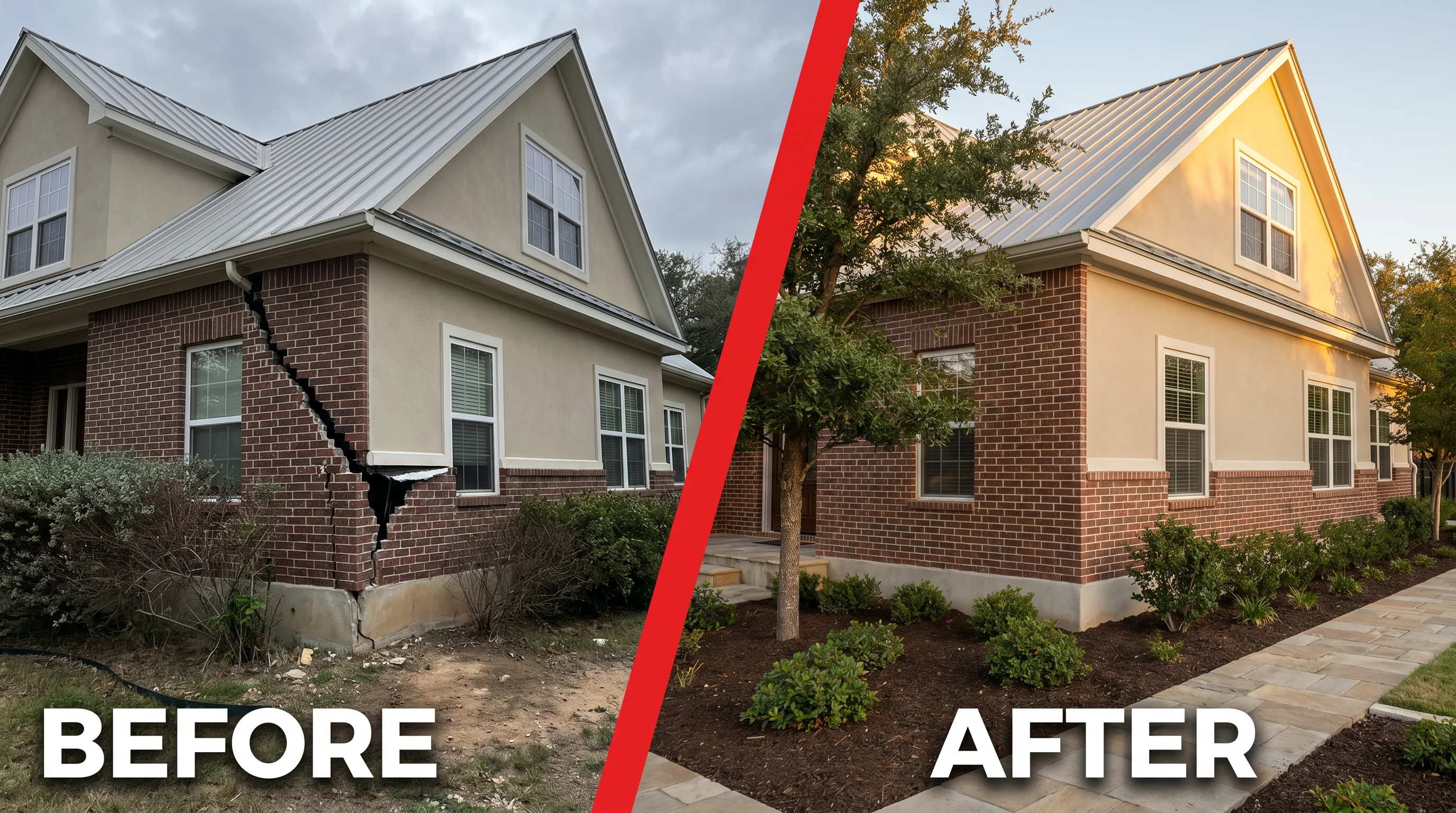
Around New Braunfels we most often set helical piles under the parts of a home that settle first: a covered porch drifting away from the front wall, a sunroom addition dropping at its outside corner, a carport post leaning off its pad. On a lot near the river with a high water table, a helical pile reaches the firm soil a pressed pier could not seat against; on a crowded side yard, its compact drive head fits where a larger rig never would.
Call (830) 302-3236Why Choose New Braunfels Foundation Repair HQ
We focus only on foundation repair, piering, house leveling, and drainage for homes and small commercial buildings across New Braunfels and the surrounding Comal and Guadalupe County towns and the Hill Country. If you are not sure whether your settlement calls for a helical pile or a pressed pier, talk it through with a local specialist and we will measure the foundation before we recommend anything.